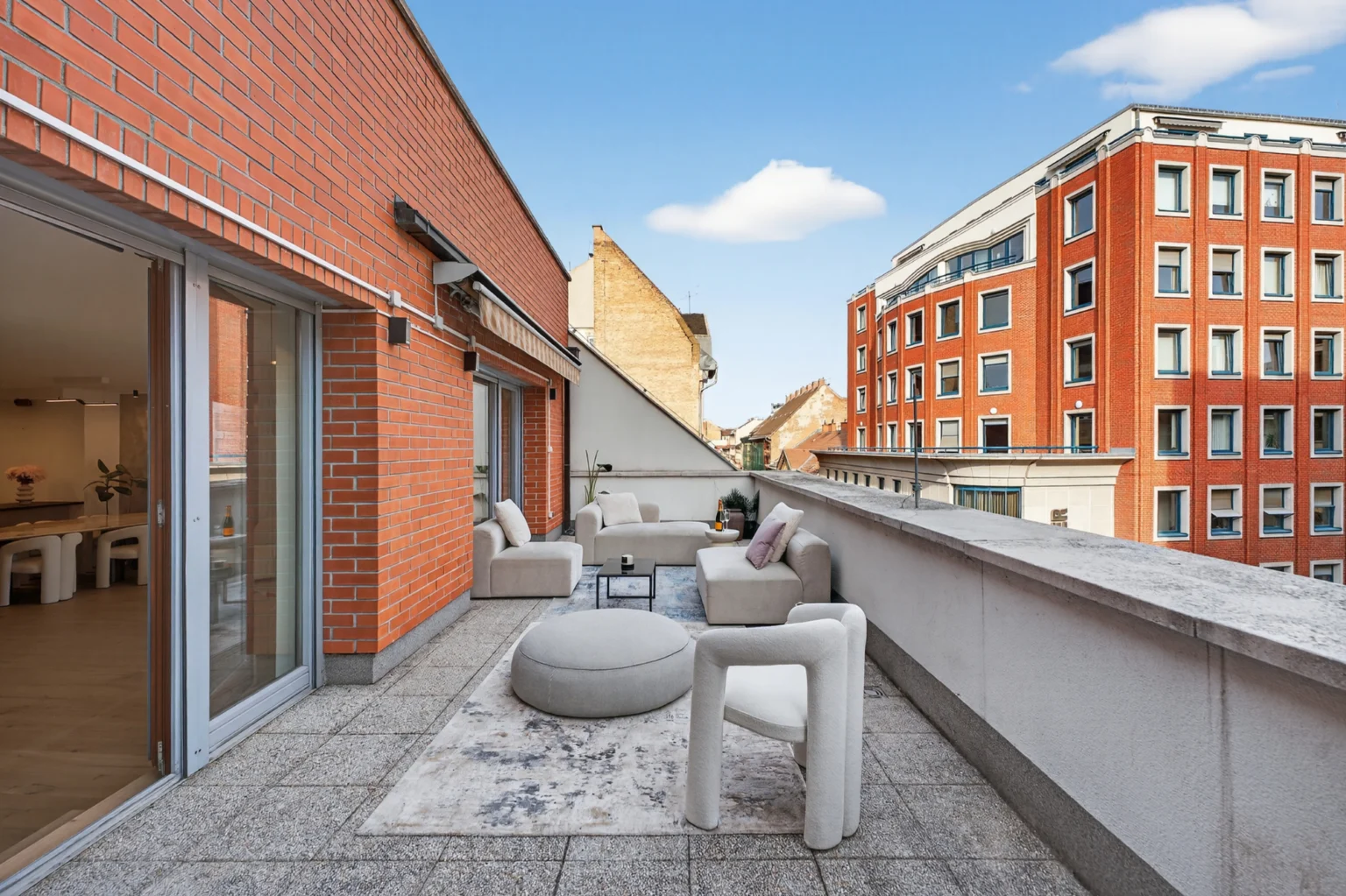
Home staging: adding value through the senses

PHOTOGRAPHY: FLOTT INVEST
WORDS: FLOTT INVEST

When a private individual sells property in Hungary, 15% personal income tax (szja) is due on the income from the sale. The income is the price minus documented costs, reduced in proportion to the time since acquisition: from the fifth year after acquisition, the sale is completely tax-free. No social contribution tax is due on the sale of residential property.
In short
- The tax rate is 15% of the income. Residential property sales are not subject to social contribution tax.
- Income = sale price − documented costs (acquisition value, value-increasing improvements, costs of the sale).
- The income is 100% taxable in the year of acquisition and the following year, 90% in year 2, 60% in year 3, 30% in year 4 and 0% from year 5.
- The income must be declared by 20 May of the following year. Tax of up to HUF 500,000 can be paid in 12 monthly instalments.
This article covers Hungarian personal income tax. If you are tax resident in another country, the sale may also have consequences there, so check with a tax adviser in both countries.
Who pays tax on a property sale?
Tax is paid by the individual who earns income from the sale. Income arises if the sale price exceeds the documented costs of acquiring and improving the property and the costs incurred in selling it. If the costs equal or exceed the revenue, no tax is due.
How is the tax calculated?
According to the Hungarian Tax Authority (NAV), the calculation works as follows:
- Revenue: the sale price, or in an exchange, the market value of what is received.
- Deduct costs: the acquisition value and related expenses (such as the transfer duty and the lawyer's fee), value-increasing improvements, and the costs of the sale, such as advertising and the agent's fee.
- Holding period reduction: depending on the years since acquisition, only part of the income is taxable.
- Tax: 15% of the taxable part.
NAV accepts costs only when supported by invoices or other authentic documents, and total deducted costs cannot exceed the revenue.
How does the tax fall with the holding period?
| Year acquired, for a 2026 sale | Time since acquisition | Taxable share of the income |
|---|---|---|
| 2026 or 2025 | year of acquisition or the following year | 100% |
| 2024 | year 2 | 90% |
| 2023 | year 3 | 60% |
| 2022 | year 4 | 30% |
| 2021 or earlier | year 5 and later | 0%, tax-free |
For both acquisition and sale, the relevant date is when the contract is submitted to the land registry, not when it is signed. A contract signed in December but submitted in January may therefore fall into the next tax year.

Worked example
Suppose someone bought an apartment in Budapest in 2023 for HUF 150 million and sells it in 2026 for HUF 260 million.
| Item | Amount |
|---|---|
| Sale price | HUF 260,000,000 |
| Purchase price | − HUF 150,000,000 |
| Transfer duty (4%) | − HUF 6,000,000 |
| Lawyer's fee on purchase | − HUF 750,000 |
| Documented renovation | − HUF 20,000,000 |
| Costs of sale (agent's fee, advertising) | − HUF 7,800,000 |
| Income | HUF 75,450,000 |
| Taxable part (year 3, 60%) | HUF 45,270,000 |
| Personal income tax due (15%) | HUF 6,790,500 |
If the same sale took place in 2028, the fifth year after acquisition, no tax would be due. For premium properties, the timing of the sale alone can be worth millions of forints.
Which costs can be deducted?
- Acquisition value: the purchase price, or for inherited and gifted property the value defined by law.
- Acquisition expenses: transfer duty, lawyer's fee, land registry fee.
- Value-increasing improvements: for example new windows, insulation, roof renovation or a heating upgrade. According to Bank360, maintenance carried out in the two years before the sale only counts if it exceeds 5% of the sale price.
- Costs of the sale: for example advertising and the agent's fee.
Collect and keep every document from the day you buy, because missing invoices years later translate directly into tax.
When is a property sale tax-free?
- When the sale takes place in the fifth year after acquisition or later.
- When documented costs equal or exceed the sale price.
- In a divorce, when one spouse buys out the other's share.
- On transfers under maintenance, inheritance or life annuity contracts between private individuals.
The earlier exemption for reinvesting the proceeds in a new home no longer exists, so using the money to buy a new home does not by itself make the sale tax-free. On the buyer's side, however, a reduced duty base may apply when swapping homes. See our guide to buying property in Budapest.
Selling inherited property
For inherited property, the acquisition date is the date of the deceased's death, so the holding period runs from then. The acquisition value is the value on which inheritance duty was assessed. If no duty was payable, for example in a direct-line inheritance, the value in the estate inventory applies. Special rules apply to the acquisition value of gifted property, so check with a tax adviser in that case.
Filing and payment
Income from a property sale must be declared in the personal income tax return by 20 May of the year after the sale, and the tax must be paid by the same date. The draft return prepared by NAV can be completed online. Individuals who are not sole traders can pay up to HUF 500,000 of tax in 12 monthly instalments without surcharge.
Where property is traded regularly and on a business-like basis, NAV may classify the income differently. If you sell several properties within a short period, seek professional tax advice.
Other costs of selling
- Energy performance certificate: the seller's obligation, roughly HUF 25,000–50,000 depending on size.
- Estate agent's fee: agreed individually. According to Bank360 it is typically 2–5% plus VAT, while an Economx survey in July 2026 put the market average below 3%.
- Lawyer's fee: the buyer's lawyer often drafts the contract, but sellers can also instruct their own lawyer.
If you sell with Flott Invest, we discuss tax considerations and the timing of the sale when setting the pricing strategy, and our tax adviser partners help with the specific calculation.
What is your property worth today, and when is the right time to sell? Ask for a personal consultation.
Frequently asked questions
After how many years is a property sale tax-free in Hungary?
From the fifth year after acquisition. For a sale in 2026, this means property acquired in 2021 or earlier.
Is social contribution tax due on selling an apartment?
No. Income from the sale of residential property is not subject to social contribution tax, only to 15% personal income tax.
What counts as the date of acquisition?
The date the sale contract was submitted to the land registry. For inherited property, the date of the deceased's death.
Can renovation costs be deducted?
Yes, if they are value-increasing improvements supported by invoices. Maintenance work can only be taken into account under narrower conditions, so check with a tax adviser.
When must the sale be declared?
By 20 May of the year after the sale, in the personal income tax return. The tax is also due by that date.
This article is general information and does not constitute tax advice. For your specific case, consult a tax adviser.
Sources
- NAV: Tax rules for property sales (in Hungarian)
- NAV: Social contribution tax 2026 (in Hungarian)
- Adózóna: calculating the tax on inherited property (in Hungarian)
- Bankinfo: Tax on selling property (in Hungarian)
- Bank360: Costs of selling a home (in Hungarian)
- Economx: estate agent commissions (20 July 2026, in Hungarian)